
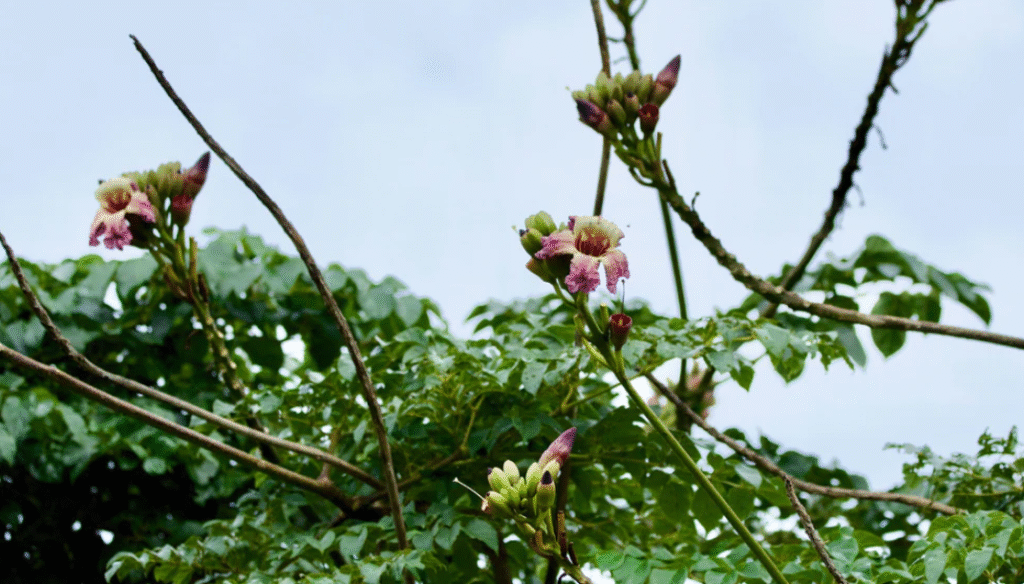
Oroxylum indicum, known as Shyonak in Ayurveda and Indian trumpet tree in English, is a culturally revered and pharmaceutically valuable tree of the Bignoniaceae family. Despite its importance in classical formulations like Chyawanprash and Dashmularishta, this species is quietly disappearing from the wild—especially across the foothills of Northeast India. To know more about the medicinal properties of the click here.
Where it grows—and why it’s at risk
Habitat and altitude: Prefers moist, shady to exposed sandy/rocky soils, mainly 250–500 m above mean sea level. Native range are Indian subcontinent (including Himalayan foothills), parts of Bhutan, Bangladesh, Indo-China boarder areas, southern China, Malaysia, and Sri Lanka.
Threat factors: Unscientific bark/root removal (often felling entire trees), poor natural regeneration due to wind-dispersed winged seeds and seed doesn’t germinate during the prolonged rainy seasons.
One of the biggest mysteries researchers sought to solve was why the plant’s natural regeneration is so poor. Oroxylum indicum produces a large number of papery, winged seeds designed to be carried by the wind. In theory, this should lead to plenty of new seedlings.
However, the study revealed a critical flaw in this natural process.
- Wind Dispersal: The wind carries the light seeds far away, often into areas that are either too dry or become waterlogged during the long monsoon season.
- Monsoon Effect: The heavy rains in the region, lasting from March to September, cause the seeds that land in unsuitable spots to rot before they can germinate.
As a result, very few new plants survive in the wild, and the population continues to shrink under harvesting pressure.
A Breakthrough in Cultivation: The Path to Conservation
The most significant contribution of the research is a simple, effective and easily replicable method for cultivating Oroxylum indicum. After experimenting with different techniques, the researchers found a clear method for the cultivation.
While vegetative propagation (growing from stem cuttings) failed to produce roots, seed germination under controlled conditions proved highly successful, with a 75-90% success rate.
The method is straightforward enough for farmers to adopt:
- Collect & Dry: Seeds are collected between October and December and dried in the shade.
- Sow in Beds: They are sown in prepared nursery beds with sandy soil during March or April.
- Germination: Sprouting occurs within 15-20 days in a shaded environment, like under a green net house.
- Transplant: Once the seedlings are established, they are moved to polybags and after 4-5 months are ready to be planted in fields with a spacing of 5-6 meters. Keeping seedlings in polybags for an additional 6 months before field planting boosts establishment.
- Soil type: The soil type required is Sandy soil or a mix of sand, humus and clay.
This breakthrough demonstrates that mass cultivation is not only possible but is the most viable strategy to meet the demands of the pharmaceutical industry while protecting wild populations from extinction.
The Road Ahead: A Call for Coordinated Action
The study provides a blueprint for saving this invaluable medicinal tree. The recommendations are clear: organized farming is the need of the hour. Government bodies, especially Forest Departments, can play a crucial role by enriching forest areas with new seedlings and promoting systemic collection methods.
Furthermore, involving the public and utilizing community or unutilized farm lands for cultivation can create a powerful synergy of conservation and economic benefit for local communities. By turning this threatened species into a cultivated crop, we can ensure that the healing legacy of the ‘Broken Bones Plant’ continues for generations to come.