
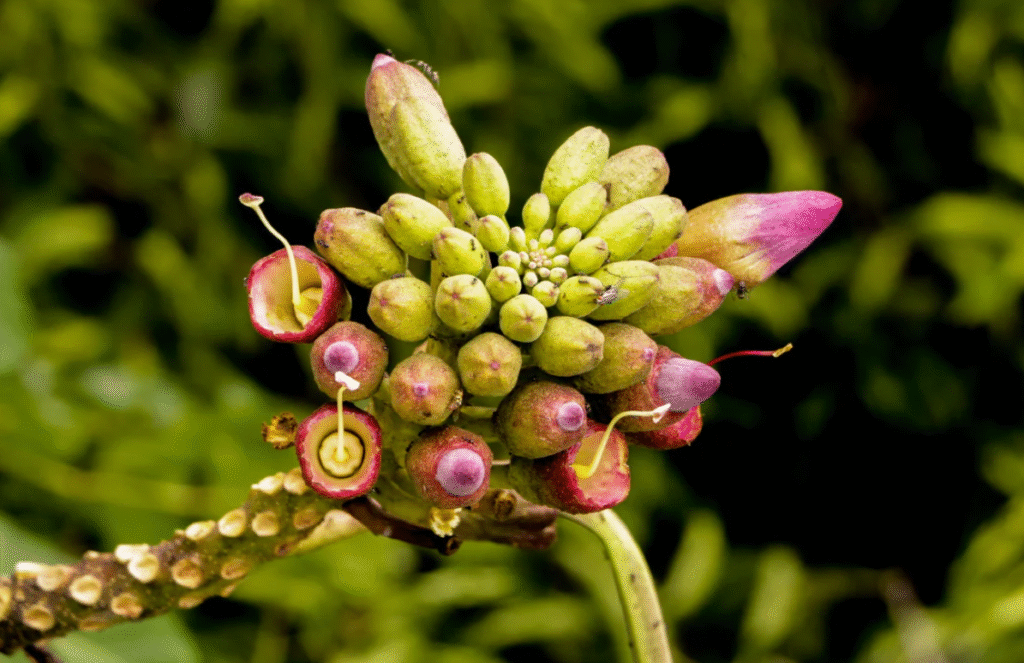
“Broken Bones Plant,” “Indian Trumpet,” and the “Tree of Damocles,” Oroxylum indicum (or Shyonak in Ayurveda) is a medicinal powerhouse deeply rooted in traditional Indian as well in some Asian healing system. Some of the common names are: Tree of Damocles, Shyonaka, Aralu, Manduk, Bhatghila, Surimana, Palai-utaicci, Cori-konnai, Manduka-parnamu, Midnight Horror, Beka, Blonglai, 木蝴蝶
Why is Oroxylum indicum So Important?
The value of Oroxylum indicum lies in its widespread use. For centuries, its root, bark, stem, leaves and even flowers have been indispensable ingredients in health and wellness.
In Ayurveda: It is a key component of famous formulations like Chyavanprash (an immunity-boosting jam) and Dasmularishta (a tonic for post-delivery recovery and general wellness). It’s revered for its astringent, tonic, and pain-relieving properties.
In Traditional Healing: Across Northeast India, healers use decoctions of the bark to treat serious ailments, including jaundice, mouth ulcers, and even mouth cancer. It is also used for rheumatoid arthritis, fever, cough, and digestive issues.
Notable phytochemicals: Ellagic acid; flavones like oroxylin A, baicalein, chrysin; scutellarein-7-rutinoside; beta-sitosterol; prunetin; and seed flavonoids (e.g., oroxin B, oroxindin) support its pharmacological interest.
Beyond Medicine: The plant’s leaves are even used for rearing silkworms, highlighting its multifaceted role in local ecosystems and economies. Even the flowers and the fruits doesn’t go waste. They are consumed as part of the cuisine in many countries.
The Silent Threat: A Dwindling Population
Despite its importance, the future of Oroxylum indicum is precarious. Researchers conducted an exhaustive survey across the foothills of Northeast India, including Arunachal Pradesh, Assam, Meghalaya, Mizoram and the foothill of Himalaya in West bengal using GPS to map the plant’s exact locations.
The findings were alarming. The plant exists in small, scattered populations, often with as few as 1-3 individuals per square kilometer. The primary cause of this decline is unscientific and destructive harvesting. To collect the valuable roots and bark, Collectors often cut down the entire tree, leaving no chance for it to regenerate. This unsustainable practice has pushed Oroxylum indicum onto the list of threatened plants.
Conservation and policy priorities
Stop destructive harvest: Avoid felling entire trees for bark or root extraction. Promote regulated, partial harvesting from cultivated sources only.
Scale community cultivation: Utilize village commons and community land for mass planting to meet industrial and local medicinal needs.
Forest department initiatives: Enrich wild populations and allow controlled collection only after population recovery.
Farmer engagement: Offer financial incentives, training, and buy-back support for cultivation to reduce wild extraction.
2 thoughts on ““Broken Bones Plant” or “Oroxylum indicum””